




The exam itself isn't the hardest part of exam season. The reporting that follows is.
(Slight overclaim. The exam is genuinely hard, and a Year 11 cohort sitting Paper 2 of Cambridge Biology on a Thursday morning is not having a pleasant time. But the exam is the visible hard, the kind everyone braces for, the kind parents ask about. What you don't see on the brochure is the four-week trench that comes after, and that's where your best teachers quietly start drafting CVs.)
If you run a British curriculum school in Kuala Lumpur, Jakarta, or Mumbai, or in any market that some of your families have language barriers (that English isn’t their first language), this post is for you. The headline argument is simple: the downstream chaos around predicted grades, reporting and parent communication is real, but it's a symptom. The cause sits upstream in how your assessments are made, marked, and tracked. Fix that, and the rest gets meaningfully better.
What Exam Season Actually Looks Like in APAC
You spend May invigilating. You spend June marking. You spend the back half of June stitching predicted grades to coursework marks to mock results, then you write 150 personalised comments while a Year 10 cohort and a Year 11 cohort do their reporting simultaneously, because of course they do. Invigilation, marking, moderation, and report writing all land in the same 4-to-6 week window. By the time the August results window arrives, your Head of Year 11 has slept through three flights and forgotten what their family looks like.
And that's if you're only running one exam board. Most British curriculum schools in APAC aren't.

Multiple Exam Bodies, Multiple Timelines, Multiplied Complexity
A typical British Curriculum international school might offer Cambridge IGCSE for Year 10–11 and Pearson Edexcel International A Levels for Year 12–13, sometimes with Oxford AQA papers in the mix, and sometimes alongside local national curriculum requirements on top of that. So far, so unremarkable. The problem is that the calendars don't agree.
Cambridge IGCSE and A Level exams run in May/June and October/November. Pearson Edexcel International A Levels run in October, January, and May/June. Edexcel IGCSE exams run in November and May/June. There is no "off-season"; only the season your senior leadership team is currently noticing.
The result, for exam officers and academic directors, is rolling administration across the whole year with overlapping deadlines, each board with its own submission portal, its own mark scheme conventions, its own moderation requirements, its own way of asking you to do basically the same thing slightly differently. Schools running two or three boards aren't doing twice the work; they're doing roughly three times the work, because the coordination tax is non-linear.
The schools that handle this well have one thing in common: they've stopped treating each board as a separate workstream. Everything, including entries, predicted grades, coursework submissions, mock results and report cards, lives in one system, mapped to one calendar. Schools running this in spreadsheets are the ones whose exam officers leave in July.
Where Teachers' Time Actually Goes
Some specific numbers, because the vibes case isn't enough.
According to GL Assessment, teachers at international schools spend an average of 6 hours and 48 minutes per week on testing and assessment. Across a 39-week year, that's 265 hours, or roughly 44 working days, that aren't going to teaching. EdWeek Research Centre data puts grading alone at five hours a week. Now multiply that across 25 to 30 students per class (extended and core tiers in the same room) and 8 to 12 question types per paper. Manual marking is the single biggest time drain in your department and the one most likely to produce errors at the precise moment they matter most.
It gets worse. Cambridge, Pearson and AQA all update their specifications on rolling cycles yearly or biannually, depending on the subject, which means a teacher running three or four subjects across two boards is trying to maintain a question bank against a moving target. (Anyone who claims they keep theirs up to date manually is either lying or hasn't slept since 2022.)
A real example: a teacher at a private school was unaware of a change to the IGCSE English First Language syllabus until two months before exams. That's the kind of thing that ends up in a parent complaint.
And here's the part that breaks the system entirely. OECD released its 2024 TALIS survey last October, and the headline finding was bleak: one in five teachers under 30 plan to leave the profession within the next five years.
In some education systems it rises to half. International schools, which lean heavily on younger expat staff, feel this acutely; teachers typically stay one to three years per posting. So the question bank, the mark scheme interpretations, the stack of past Paper 1s with marginal annotations? When the specialist leaves in May, that goes with them. The next teacher starts, and I cannot stress this enough, from scratch.
The Coursework Burden Nobody Talks About
Coursework such as non-exam assessment, NEA, controlled assessment, whatever your board calls it, is one of the most structurally demanding and underappreciated parts of British curriculum exam season. Cambridge, Pearson and Oxford AQA all include internally assessed components: portfolios, speaking tests, practical work, extended writing. Teachers mark them, the department standardises them internally, and then a sample goes out for external moderation by the board. All to strict deadlines. All while May exams are happening.
The compliance load is real, too. Per Ofqual guidance for schools and colleges, schools have to store live coursework securely, give students their internal assessment marks with enough time for an internal appeal, and make clear that submitted marks can change through external moderation. These are not optional. They are, however, deeply tedious to track manually across 8 to 12 subjects and two year groups.
For a single subject, say, IGCSE English First Language, teachers internally moderate every portfolio, submit marks for the full cohort, and ship a sample of marked work to Cambridge for external moderation. Now do that for English, History, Geography, Art, DT, Drama, Music, the practical components of all three sciences, and the speaking tests for two languages. Coordinating that, across 8 to 12 subjects, two year groups, and three boards, in schools without integrated systems, is almost entirely a manual job. It mostly works. The exceptions are the bits that end up in post-results appeals.
Predicted Grades: High Stakes, Low Infrastructure
Predicted grades matter more in the British curriculum context than schools sometimes realise, especially for Year 13 students applying to UK universities through UCAS, where predicted A Level grades are the primary admissions signal sent months before results. Getting them wrong has real consequences for individual students.
Ofqual's guidance is that when producing indicative grades, schools should focus on the underlying content, knowledge and skills required for each qualification, rather than mapping mock performance directly onto last year's grade boundaries — because boundaries vary year on year. This is sensible advice and also, in practice, hard to follow when the underlying data lives in five different spreadsheets owned by five different teachers who are also marking mocks.
In most schools, predicted grades are assembled manually by form tutors or Heads of Year, pulling from mock results, internal assessment marks, and coursework grades that aren't connected to anything. Component-level tracking (Paper 1, Paper 2, Paper 3, plus the coursework component) sits in tabs. The reporting system pulls from a different tab. The UCAS submission pulls from a third. Someone is copying numbers between them at 11 pm in early March. This is the workflow that determines university offers.
The Reporting Tax Nobody Costed
This is where the real damage compounds, and it's the part that schools systematically underestimate when they budget exam-season workload.
Schools run dual-track reporting: internal predicted grades for board submission, plus a school report card for parents. Two separate data events, with different deadlines and different audiences. IGCSE students take 8 to 12 subjects, so a single report card needs input from 8 to 12 teachers, all of whom are also marking, also invigilating, and also doing their own subject's reporting. Coordinating those inputs before the deadline is the kind of administrative problem that makes a perfectly competent Academic Director consider a career in landscaping.

Then come the parents. British curriculum families in APAC are engaged, in the sense that they will email you with follow-ups about a single grade descriptor. They want clarity, and ideally, they want it in their home language, which manual translation cannot keep up with. Add the months-long gap between your internal predicted grades and the August results release, and you're now also explaining to confused parents why their child's "predicted A" became a "final B," or, more often, why the two numbers exist at all.
Multiply error surface (8 to 12 subjects times hundreds of students times multiple grade components) by exhausted humans doing manual proofreading, and the maths gets ugly. Wrong grades, mismatched names, missing components, and copy-paste errors in pronouns. A Head of Year, doing this by hand at scale is not going to catch all of them. They might catch most. Most isn't good enough when one of them is your top student's chemistry grade.
Student Wellbeing Isn't Just a Pastoral Issue Anymore
This used to live in the wellbeing committee minutes. It increasingly lives in the school's reputational risk register and, in some jurisdictions, its regulatory file.
A UK government poll found that half of students who completed their GCSE-level exams in summer 2024 found it difficult or very difficult to cope with the stress during that period — and for students completing 16–19 exams, the figure was higher still. International schools in APAC face compounding pressures on top of that: students often sit qualifications from two different boards in the same window, may be studying in a second or third language, and face intense family expectations around results.
What's often missed is that the school's own assessment practices contribute directly to this. Poorly designed mock papers (wrong difficulty calibration, formatting that doesn't mirror the real exam), inconsistent marking across teachers, unclear feedback that doesn't show students how to improve — all of these increase anxiety without adding learning value. A student who has done six well-structured mocks under real conditions sits the real exam differently from a student who's done one cobbled-together past paper their teacher photocopied at 7am. The wellbeing case and the operational case point at the same fix.
And Now, the Digital Transition
In June 2026 (so, this exam window, like, right now as you read this), Cambridge International Education is running digital exams for the first time, beginning with multiple-choice components of IGCSE Accounting, Economics, Biology, Chemistry and Physics, plus the Cambridge International AS English General Paper. The pilot is regional: schools in Europe, the Middle East and North Africa, and the US. The global rollout — the one that lands on APAC — starts in June 2027. By 2033, Cambridge wants 85% of its high-stakes qualifications to have a digital option.
If you're reading this from Penang or Pune, your first instinct is probably great, I have a year. That's the wrong instinct. (Or rather, it's a reasonable instinct that will end badly.) Schools that haven't run any digital assessments by the time the global rollout hits are walking in cold, and "walking in cold" here means students who have never used a digital highlighter on a science MCQ trying to do exactly that on a paper that determines university admission. Cambridge has been explicit that familiarisation matters. The schools getting ahead are the ones already running digital mock exams in low-stakes settings, this term and next.
The infrastructure question is real, too. Software installations and updates across devices become a new administrative job. Wifi capacity that comfortably handles a normal teaching day collapses when 80 students simultaneously start a lockdown browser. The schools finding this out in June 2027 are going to have a worse summer than the schools finding it out in November 2026.
Start Upstream
The reporting nightmare downstream is real, but it's a symptom. The cause is that your teachers are spending most of their non-teaching hours making and marking the assessments that feed it. Solving the upstream and the downstream gets meaningfully less catastrophic.
Two products, both in the Faria Education Group ecosystem, are the obvious move here. (Disclosure flag: this is a ManageBac+ blog post, so of course, we're going to recommend ManageBac+. The reason it's still worth reading is that the underlying argument — digitise upstream first — holds whether you use these tools or someone else's.)
The Assessment Layer: AssessPrep

AssessPrep handles the create-deliver-grade-analyse loop. It ships with 40,000+ ready-aligned resources, 20+ interactive question types (the same shapes as Cambridge digital papers, including MCQ, structured data, graph and draw), a lockdown browser for exam security, and AI-powered grading that works on both digital submissions and handwritten scans. Across the platform, there are over 800 customer schools and more than 4 million assessments delivered — enough volume that the workflow has been beaten on by actual humans, not just designed by product managers.
How that maps to the challenges above:
-
Marking burden → 3-minute paper grading. AI-assisted marking on both digital and scanned handwritten responses takes the five-hour-a-week grading job and bends it sharply downward. Teachers still review and override; the time goes back into teaching, not into a spreadsheet.
-
Specification drift → a question bank that stays current. Resources are aligned to live specifications across Cambridge, Edexcel and AQA, so when the syllabus moves, your assessments move with it. The "specialist left in May" problem stops being existential.
-
Digital exam readiness → low-stakes dress rehearsals now. Question papers mirror Cambridge IGCSE digital past-paper formats, which means Year 10 can sit familiar interfaces in mock conditions this term, not for the first time in June 2027.
-
Student wellbeing → fewer, better mocks. Consistent question types, consistent marking, and proper analytics on where individual students are struggling. The mocks do learning work, not just stress-induction work.
-
Coursework burden → centralised submission and moderation tracking. Internally assessed components, sample submissions and moderation evidence live in one place rather than across drives, inboxes and physical folders.
The Reporting Layer: ManageBac+
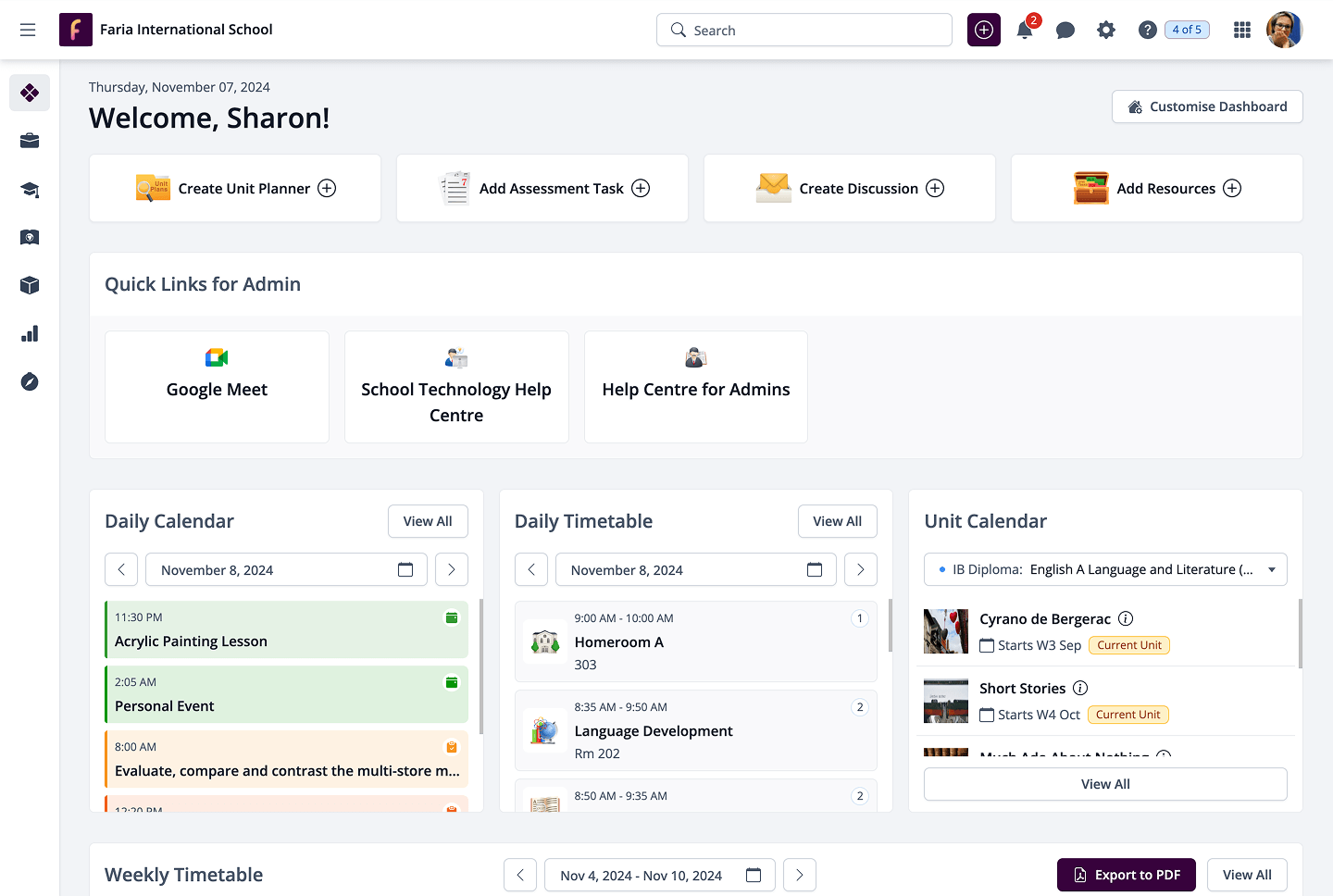
ManageBac+ is where the assessment data turns into reports. AssessPrep grades sync directly into the ManageBac+ gradebook, which means predicted-grade submission and report-card generation pull from the same source of truth as your formative assessment data.
How that maps to the challenges above:
-
Multi-board coordination → one calendar, one system. Entries, deadlines, predicted grades and coursework submissions for Cambridge, Edexcel and AQA all live in the same place. Your exam officer has one screen, not seven browser tabs.
-
Predicted grades → an evidence-based picture, not a guess. Component-level grade tracking (Papers 1, 2, 3 and coursework) lives inside the system, drawing on mock results, internal assessments and coursework marks. No 11 pm spreadsheet copy-paste.
-
Report writing → built-in error checking. Catches the things that make Heads of Year cry at 2 am: missing grades, missing comments, wrong pronouns copied across 30 reports.
-
Parent communication → bilingual reports out of the box. Reports are generated in additional languages of instruction, which matters more in APAC than anywhere else. The bilingual report card problem is not optional for schools serving Korean-, Japanese-, Mandarin-, or Bahasa-speaking families.
-
Coursework portfolios → a real VLE, not a shared drive. Submissions, marking, internal moderation evidence and external sample selection all sit in one workflow with visibility for the Head of Department.
The combined effect, when it works, is that one teacher's assessment work becomes the foundation for the whole school's reporting. The 44 days a year your teachers lose to assessment admin don't go to zero (nothing in education goes to zero, and anyone who tells you otherwise is selling something worse than what we're selling). But it bends. And the bend is the difference between a sustainable British curriculum programme and one that haemorrhages staff every June.
The Schools Getting This Right
The schools getting this right in 2026 are not the schools with the most resources. They're the schools that started early, ran one digital mock per subject this academic year, and used the experience to figure out where their workflow actually breaks. The ones who wait until June 2027 to find out their wifi can't handle 80 simultaneous lockdown sessions, or that their teachers haven't seen the digital interface, or that their predicted-grade workflow still lives in a spreadsheet someone forgot to share — those schools are going to have a bad summer.
The first digital Cambridge IGCSE exams are happening as you read this. The next ones are yours.
What to Do Before Half-Term
Book a 20-minute demo of AssessPrep and ManageBac+. Run one digital mock per subject this term. Find out where your workflow breaks while you have twelve months to fix it, not twelve days. (You technically have twelve days too. We don't recommend it.)